
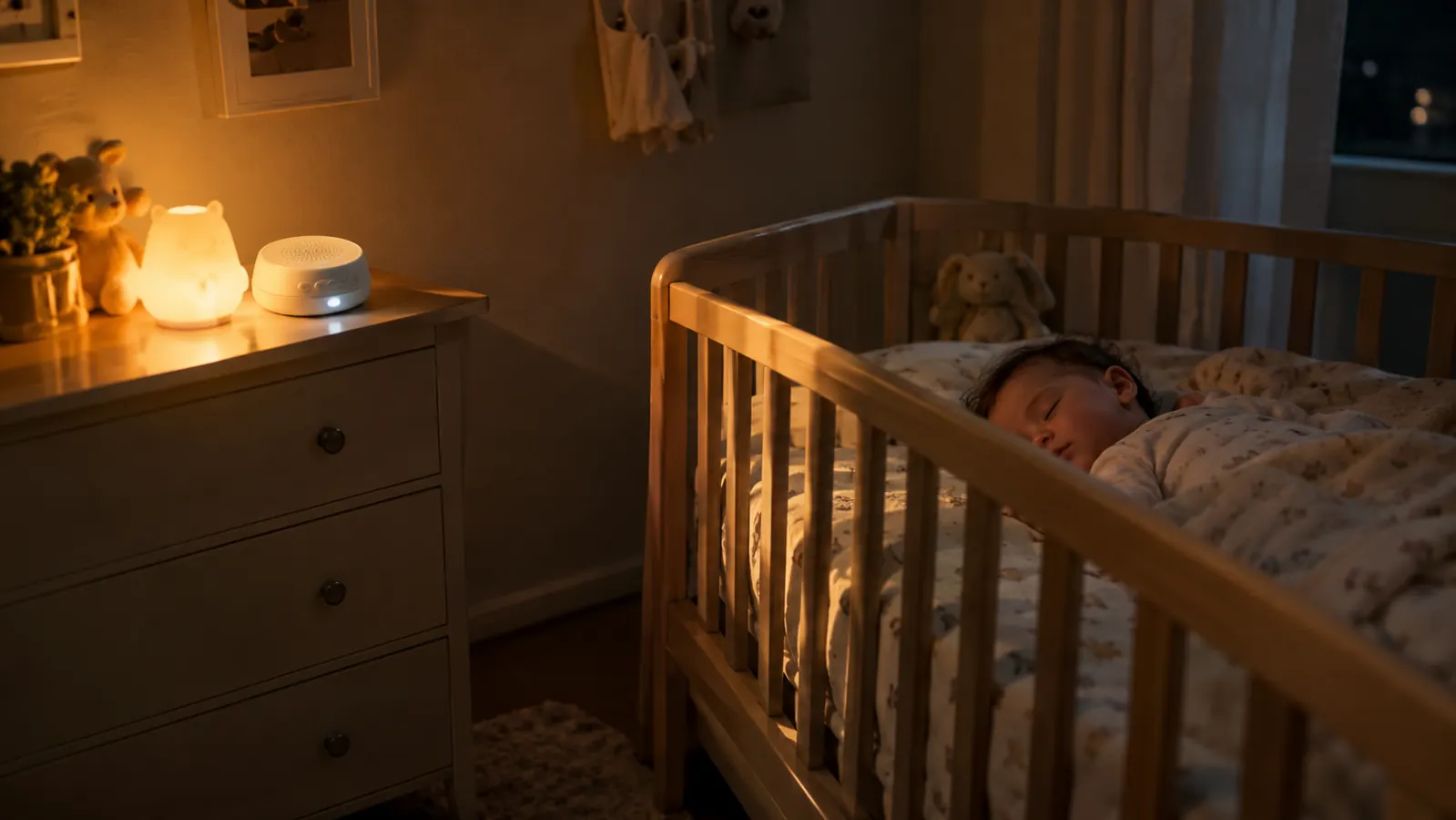
Somewhere around month four, I lost the plot. June would rub her eyes at seven, I would rock her for twenty minutes, and the second I set her in the crib she would pop awake like a toaster. One night in late March, I counted eleven wake-ups between 7:30 and 9:00. Mike would take a turn, then I would take her back, and by nine we were both sitting on the nursery floor in the dark, exhausted and a little embarrassed. The baby was not broken. The routine was.
I am Kara, a former pediatric dental hygienist and now a stay-at-home mom outside Knoxville, Tennessee. My son Eli is five, and my daughter June is eight months old. I have built exactly two bedtime routines from scratch, and the second one went a whole lot better than the first. The difference was not a magic trick. It was a sound machine and night light called the Hatch Baby Rest, plus a simple five-step plan I could repeat the same way every single night.
Before I found that plan, I tried the usual shortcuts. I played white noise from my phone, and it worked for about a week until the phone died at 2 a.m. and the silence woke June up. Then I tried a tablet with a lullaby playlist, but the screen glow kept her eyes open and the playlist ended halfway through the night. What I needed was something that made the same sound and the same light every night without me having to remember to start it. That is what finally pushed me to try the Hatch Baby Rest.
The Hatch Baby Rest turns a loose bedtime idea into a routine you can repeat
Sound, light, and a timer in one small machine. Set it once, and the same calm sequence happens every night, even when you are running on three hours of sleep.
Amazon Check Today's Price on Amazon →Step 1: Pick a fixed bedtime and a fixed wake time
Before I touched any settings, I picked a bedtime and a wake time and wrote them on a sticky note. For June that was 7:30 at night and 6:45 in the morning. I picked June 1 as the start date and marked it on the kitchen calendar. The exact times matter less than the fact that they do not move. A routine is just a sequence of events the brain learns to expect, and the brain cannot learn a sequence that starts at a different time every night.
I know how tempting it is to push bedtime later so the baby sleeps in. I tried it with Eli when he was about June's age, and it backfired completely. He woke up at the same time anyway, just crankier, and the later bedtime meant he was overtired by the time we finally got him down. Overtired babies do not sleep better. They sleep worse. With June I kept the times steady for two full weeks before I judged anything.
The Hatch Baby Rest has a built-in schedule, so I set the same times in the app and let the machine hold them for me. I set a wind-down light for 7:15, the sound to come on at 7:30, and the light to shift again at 6:45 in the morning. For the first few days I still had to do the work. But the machine kept the schedule honest, and after about ten days June started stirring right around 6:45 on her own, before the light had even changed.
Step 2: Build a short, boring sequence before the machine comes on
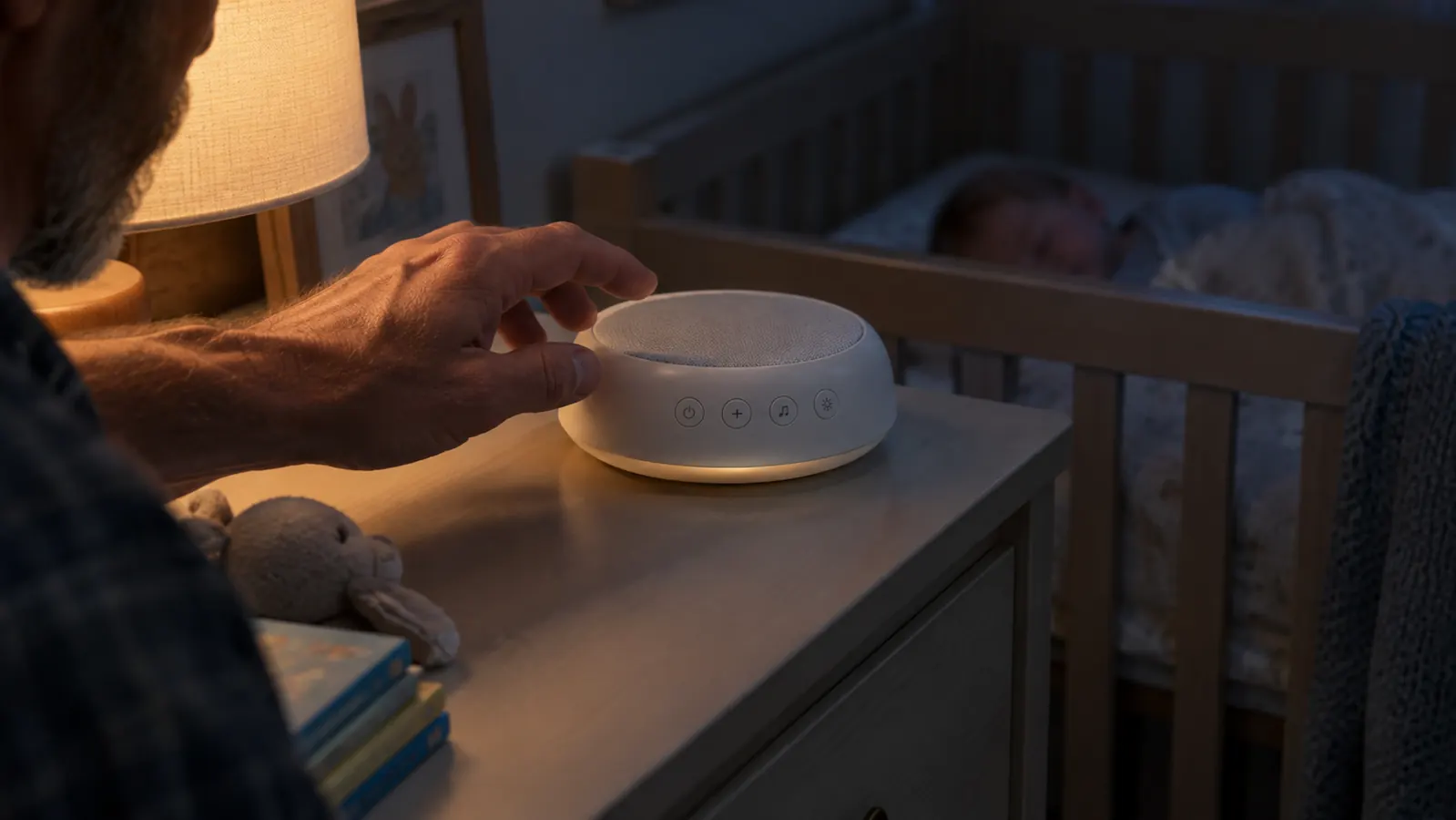
The routine itself should take about twenty minutes and should be the same every night. Ours is bath, pajamas, one book, then the Hatch Baby Rest. Bath at 7:05, pajamas at 7:15, book at 7:20, machine on at 7:25, and June in the crib by 7:30. That is it. No TV, no extra play, no one more song that turns into four more songs. Boring is the point. A bedtime routine is not supposed to be entertaining. It is supposed to be predictable.
I learned this the hard way with Eli. I let him pick the books and the songs and the order of everything, and bedtime stretched to an hour. Some nights he would ask for a different book halfway through, then a different song, then water, then the bathroom. Every choice was an invitation to negotiate. With June I keep the sequence short and I do the same steps in the same order every night. The bath is not a soak, it is a quick rinse. The book is one book, and for the past two weeks it has been the same board book about a sleepy bear. June does not care which book it is. She cares that it is the same.
There is a reason I put the machine on at the same point every night rather than at the end. The routine is not bath, pajamas, book, and then a separate step where the machine comes on. The machine coming on is part of the routine, and it happens in the same spot every night. June does not get to ask for more after the machine is on. The sound starting is the signal that the fun part of the day is over and the quiet part has begun.
Step 3: Use the Hatch Baby Rest as the cue, not the reward
Here is the part that changed everything for me. The Hatch Baby Rest is not something June gets after she settles. It is the signal that settling is about to start. I turn it on while she is still calm and happy, right after her book. The sound starts, the light shifts to the low warm color I picked, and she knows what comes next even before I pick her up.
The Hatch Baby Rest has a library of sounds, from white noise to gentle lullabies, and a night light that can be set to different colors and brightness levels. I use the same sound and the same dim light every night. The machine does the reminding so I do not have to. When the light changes, June starts winding down on her own. That is the whole trick, and it is not a trick at all. It is just a consistent cue.
I will be honest about what did not work. For the first week, I treated the machine like a reward. June would fuss, I would turn the sound on, and she learned that fussing turned the sound on. That is the opposite of what I wanted. I had to reset the association, which took a few days of turning it on before any fussing started. Once the machine became the beginning of the routine instead of the response to a problem, bedtime got calmer. The cue has to come first, every time, whether she is happy or cranky.

Step 4: Put the baby down drowsy but awake, then let the machine do the rest
This was the step I dreaded, because it is the one that sounds impossible. The goal is to put June in the crib when she is sleepy but still awake, so she learns to fall asleep in the crib instead of in my arms. The Hatch Baby Rest does not do this for you. It just makes the room feel the same every time she drifts off, so when she stirs at 2 a.m. and sees the same dim glow and hears the same sound, she knows she is in the right place.
I followed safe sleep basics the whole time: June sleeps on her back on a flat, firm mattress, and the crib has nothing loose in it. No blankets, no pillows, no stuffed animals. The Hatch Baby Rest sits on the dresser, well out of reach, and its cord is tucked away. I checked the manual before I set it up, and I would tell anyone to do the same. When in doubt, ask your pediatrician. That is not a disclaimer, it is what I actually did.
The first few nights of drowsy but awake were rough. I would put June down and she would cry, and I would pick her up, calm her, and put her down again. I set a little rule for myself: five minutes of trying before I stepped in, unless she was truly upset. By night four she was falling asleep within about ten minutes of being put down. By week two she was out before I left the room. The machine did not do that part. The consistency did. The machine just made the room the same every single time, so the crib felt familiar at 2 a.m. and at 7:30 p.m.
Step 5: Use the same routine for naps and for middle-of-the-night wake-ups
The routine does not stop working just because the sun is up. For naps, I do a shorter version: diaper change, one book, Hatch Baby Rest on, lights down. Same sound, same light, same crib. June naps better because the cues are the same as bedtime. The machine has a timer, so I set it to run for the length of the nap and it turns itself off. For us that is usually about an hour and a half in the afternoon.
The timer was the feature I almost did not use, and it turned out to be one of my favorites. I set the sound to run for thirty minutes for a nap, or overnight for bedtime. When June wakes in the middle of the night, the sound is still there, the light is still the same dim glow, and nothing about the room has changed since she fell asleep.
And when June wakes up in the middle of the night, I do not turn the lights on and I do not start a conversation. I check her, make sure she is dry and not hungry, and let the sound and the dim light do the calming. If she needs me, I am there. But most nights she just needs the same quiet room she fell asleep in. I also set the morning light to shift to a brighter color at 6:45, so when she does wake for the day, I can tell a real wake-up from a middle-of-the-night stir before I even walk in.
What Else Helps
A sound machine is one tool, not the whole system. A few things made the routine stick for us. Blackout curtains helped a lot in the summer, because June's room gets bright at 6 a.m. A consistent wake time mattered as much as a consistent bedtime. And I stopped checking my phone during the routine. The glow of a screen is exactly the kind of light that works against a calm wind-down. I also keep the routine the same on weekends. It is tempting to let bedtime slide on Friday night, but babies do not know what a weekend is. The Hatch Baby Rest does not care what day it is, and that consistency is what makes the whole thing work.
One more thing: I gave the routine a full two weeks before I changed anything. The first three nights were not better than what we had before. The fourth was a little better. By the end of week two, bedtime had gone from a ninety-minute struggle to about twenty-five minutes from bath to lights out. If I had given up on night three, I would have missed it. The machine helps, but the time frame matters too. Even Biscuit, our nine-year-old yellow Lab, has learned that when the sound comes on, she settles down on her bed in the corner. It was not a sound meant for dogs, but she seems to take the cue.
Rough nights are part of it, too. When June was teething last month, she needed extra rocking and a call to our pediatrician before she settled. I still kept the same sequence: bath, book, machine on, lights down. The machine did not fix the teething. But when she stirred at 3 a.m., the room still felt like her room, and she settled back down faster than she would have in silence.
By the end of week two, bedtime had gone from a ninety-minute struggle to about twenty-five minutes from bath to lights out.
Give your baby the same calm cue every single night
The Hatch Baby Rest makes a bedtime routine repeatable, even on the nights when you are too tired to remember your own name. Set it once and let it hold the routine for you.
Amazon Check Today's Price on Amazon →